Tuesday, March 18, 2014

Ozymandias

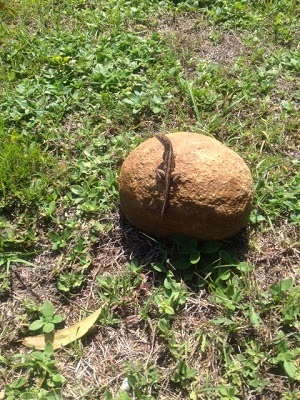
It has taken me months to charm this King of Round Stone. I call him Ozymandias, though certainly not to his face. I am sorry he doesn't trust me -- or so I have felt for the longest time. But today, of all days, blessed by abundant sun and trust, he lets me creep up to his vast castle of rock. And having crept, I stop and stare and he casts a wary eye upon me, but permits me to press the button and capture his image for all, or anyone, to see. And here is a verse to commemorate the day ....

And on the pedestal these words appear:
"My name is Ozymandias, king of kings:
Look on my works, ye Mighty, and despair!"

Percy Bysshe Shelley, 1792-1822


Monday, March 10, 2014

Copperhead Necktie


This morning in the golden sunlight along came a serpent. Marked like a copperhead he was instead a lovely young cornsnake just up from a hibernation nap. Knowing cornsnakes are friends, I scooped him up and Lorry took a quick pic of him sliding around my neck and off my back. He was out for lizards and I didn't want to keep him from his early morning hunt. I set him down and he slid gracefully into an asparagus fern and disappeared.

I was five years old when I met my first cornsnake and this is how it goes:

Just up from a nap
out in the yellowy tassles

the hired hand hung something loose
back of my neck

belly scale shiny feel
a burnt umber
copperhead necktie.

____

It was the hired hand, Ray, who said it was a copperhead. All these years it took me to find out it wasn't, or shouldn't have been, but maybe still could've been but, more likely, it was a cornsnake like the one that just visited us.


Sunday, February 23, 2014


Once again Longhouse Publishers in Vermont has produced a book exquisite in design, fat enough to be a feast, pretty enough to just wade around in, and deep enough to dive into and stay with for days and weeks and even months on end. Could be it's the first of its kind, a scrapbook novel that is also a how-to and a mystery -- how did he do it, and how does he make rocks balance like Thor?

Author Bob Arnold is a poet, well-known for well-crafted verses of the back country. But Bob Arnold the builder, the stone mason, the rock wall maker is for those of us lucky enough to have gone walking on his grounds or dining in house with his lovely wife, Susan. 

I've known these guys a very long time, but frankly it takes a long time to know people who have the woods in them. They are like trees you love to look at, and you can give them a good hug, but that doesn't mean you know them. It takes years to do that and even then there's more mystery below the bark.

Well, there are years upon years in this shining, stunning photographic book of buildings, walls, stones, woods, flowers, lakes and of course trees. It's a book of family built with love, and like each rock, hand-held and sort of loved into place, it's a book that couldn't have come in a night or a day. It's taken Bob Arnold a lifetime to write it as his life was written around him in loving circles of tribute to his wife and son.

The beauty of this book is that it is truly a scrapbook novel, as solidly true as stone and bark. And it's not about one house, it's about many, and all made by the same man,woman, and son. If you want a life you have to make one. This is the story of a family who did just that. 

http://www.longhousepoetry.com/

Friday, February 14, 2014

This Day I Saved To Think Of You

On brown grass
charred with cold
I see two, not very old
friends, kissing

Could be they're
husband and wife
curious creatures
who mate for life

Or are they two
infrequent friends
rubbing cheeks
to make amends

Whatever it is
they're only two
this day I saved
to think of you

How straight their necks
so fine and tall --
Canadian geese at
the shopping mall.

Wednesday, February 12, 2014

The Long and Short of Roger Zelazny: imagining dessert before the meal

Roger Zelazny was an undisputed master of the long and the short sentence.

Here's one of his short ones ...

Such
is
the
kingdom
of
ice
of
ice
such
is
the


And there it ends, frozen. No way to beat that sentence for sound and sense, implication and verification. It's what it is, just as ice is what it is. A long, linear line of coldness, it catches you in its iciness, and makes you wonder. The line comes from To Spin Is Miracle Cat.

My other favorite a scroll of wondrous imagery that plays out before the eye in a dazzle of prose poetry:

" ... Places of foundation, where dark streams through darkness flow, blind fish borne through caverns measureless, walls fungus-bright, delineating face and form of all the ancestors of all the tribes of the world, delicate fronds splayed amid coalsheet, beaver, deer, father to himself the bear, the cats, the fish people, bird he had dreamed lifetime but moments before, snake, bat, raccoon, wolf, coyote, and all the insect-folk, amber-cased, dreaming the dream of Her body amid jewels and lakes of oil, and hot rumble of melted rock flowing forever, deep, deep, and light of underworld about him now, and even man and woman, hairy hunters, wanderers in the earth forever, and the big flowers, the strange, unknown flowers, him padding by, blood upon his muzzle, in his mouth his throat, and throws back his head and roars that the underworld know that yet he moves, that nothing has stayed his course since the very beginning."

The above unbroken single sentence comes from the novel that Roger wrote with me, Wilderness, the story of mountain man John Colter and hunter Hugh Glass. One man, Colter, runs across the western landscape chased by the best runners of the Blackfeet nation. The other, Glass, crawls after being eviscerated by a grizzly bear and buried alive by his fellow hunters. Colter's naked but for a loincloth, and it is winter. Glass doesn't have the weather against him, but he's got a torn-open belly and he is more "thing" than man.

Curious info on the Master -- Roger used to select his dessert with me in a restaurant before he ordered his meal. Why? Because he always wanted to be sure he had room for that dessert. When he opted to write Wilderness with me, I imagine he saw the illuminated book in his mind before he began writing a single word. Some of that scroll above must've flashed before the screen of his consciousness before he said yes to me. It took him a year or more before he put the menu down and ordered the whole book, and at one time, he actually considered "buying the idea" from me. I would've said no. But before he asked me that question I gave him the first chapter. I remember him saying, "This is good. This is very good." The menu was put away.

We worked together. And each morning he brought my wife Lorry a scone.

To tie this all together -- you must dream first, you must spin like miracle cat, you must have the mind of winter to write about ice. You must walk softly and carry a scone. You must write as if it were your first and last sentence.

Love you, Roger. Always.


Tuesday, January 28, 2014

Pete Seeger, Ray Brock, Henry David Thoreau: Notes on a Berkshire Map


It was the summer of '63. We were driving my dad's 1957 Ford station-wagon on Rattlesnake Mountain Road outside of Stockbridge, Massachusetts. I had just graduated from high school. I wanted to be a folksinger -- and there on this twilit country road was a tall man and a short man, walking. I recognized the tall guy immediately and slowed the car. I was keeping pace with them for a moment. The tall one was Pete Seeger, the shorter one was twelve-string guitar master, Bob Davenport from England.

I pulled the station-wagon over to the side of the road. I got out and walked over to Pete and said, "You mind if I walk with you?" It was brazen, and foolish. Pete looked at Davenport with less than a smile and more of a question mark. Davenport whispered, "I'd like to know what they're thinking, these American kids." Pete turned to me and said, "Come along then." I waved to my cousin Kyle and she got behind the wheel and drove off ... and I was alone with a legend and the legend's friend, who was really the one permitting the walk-along-side.

In my memory that walk lasted forty hours. But whatever time it took walking the length of it and then coming back and walking another length was sweet to me because these two great musicians were talking about everything under the sun. And then -- after the real sun sank behind Monument Mountain, Pete made that statement I'll never forget: "If you squeezed that mountain the sap would run out and turn into culture." I knew what he meant -- the Berkshires of Massachusetts was the heartland of New England poetry, prose and let's not forget maple syrup. The way Pete said it, and explained it, the dripping sap off that mountain contained the souls of Hawthorne, Melville, Thoreau, Stowe, Sedgwick, Bryant, Longfellow and the rest.

After a while we sat down in a field and counted fireflies. I'll never forget that night. Nor will I forget, some years later meeting another folk legend, Ray Brock who gave me a pancake recipe that he liked to use in the Virgin Islands on a Baltic ketch, "and don't forget the fresh nutmeg" -- and I never do, Ray!

All this may seem like a long time gone, 1963-1968, but to me it's the wink of a firefly on a summer's night.


Monday, January 27, 2014

How Do I Sell My Book?

www.AndrewLamMD.com


In recent months writers have asked the same questions at our workshops. How does one get a book up and running? How does one get a newly published book into the bestseller category? What are some of the secrets of learning how to be a writer whose first book succeeds right from the start?

We asked first-time author Dr. Andrew Lam who is one of our Irie Books top-selling writers if he would share the secret of his success with Saving Sight: An eye surgeon's look at life behind the mask and the heroes who changed the way we see. 

His response (below) is candid, clear and correct as far as the procedure one needs to follow in order to make a book into a success. Andrew's background is scientific and medical, yet his approach to book marketing is creative and inspirational. He is a retinal surgeon with a history degree from Yale and an assistant professor at Tufts School of Medicine. Dr. Lam resides in western Massachusetts with his wife and four children. 


HOW I MADE MY BOOK AN AMAZON BESTSELLER

Eight months ago, Irie Books published my first book, Saving Sight, which blends my experiences as an eye surgeon with the stories of medical heroes whose inventions saved the sight of millions around the world.

Since its launch, Saving Sight has been an Amazon bestseller in its category (ophthalmology) and sold thousands of copies. It won awards from the New England and London Book Festivals. I was flattered when my friend Gerry invited me to share the things I’d done to promote my book. I drew up this list, which I hope may benefit some fellow writers out there.


1. It’s all up to you.

From the start, my attitude was to take complete ownership of the success or failure of my book. Yes, your publisher will help market your book, but it’s useful to adopt the mindset that it’s all up to you. This keeps you alert, engaged, and constantly trying to think of ways to get your book into readers’ hands. Besides, no one is going to care about the success of your book as much as you will.

So, if you’ve just gotten your first book published, give yourself a brief pat on the back and then start learning the new skills necessary to promote it yourself. Don’t waste time waiting for others to do it for you.


2. Marketable? It better be.

Like a lot of first time authors, I loved writing my book. There were no deadlines, no expectations. I wrote in my spare time and did it because it was fun. I also knew I had a good, marketable idea, and I didn’t think anyone else had the expertise or ability to write a book like mine.

My first idea was to write a nonfiction book profiling a group of heroic medical underdogs—with my degree in history and familiarity with the scientific literature, I was well-poised to do this. Later, I realized my book would appeal to a far larger audience if I blended those stories with exciting episodes from my surgical training—to show what it’s like to learn LASIK and cataract surgery; to reveal how surgeons feel when they aren’t sure what to do; to share the joy of saving someone’s sight; and to be honest about what it’s like to fail, when failure can mean blindness.

No one had ever written a book like this. There was no competition. And, even if it didn’t catch fire with the general public, I knew there’d always be a niche audience of eye doctors and patients who would buy it.

In short: the importance of having a ready audience for your book cannot be overemphasized.


3. Write the absolute best book you can.

Books sales grow from word of mouth. Readers recommending books to their friends is a far more effective form of promotion than advertisements, media interviews, or even book reviews. No one beyond your circle of family and friends is going to buy your book unless it is actually good. So do all you can to make sure your book is the best it can be. I spent countless hours writing and re-writing my book. I showed it to a lot of readers and took their advice. I listened to my agent's and editor’s suggestions and took them to heart. If your book isn’t good, it won’t sell.


4. Make it look good.

Presentation. It’s important. And no one will care as much about the presentation of your book, website, or Amazon landing page as you will. I worked closely with my book designer to make sure the cover and layout were as perfect as possible. I made sure to have a nice-looking, professional website. When the book launched, I quickly learned to navigate Amazon’s Author Central and “Look Inside” functions to make sure everything about my Amazon landing page looked attractive.


5. Have an “all of the above” promotion strategy.

When I sat down and thought about what I could personally do to promote my book, I divided my efforts into three categories.

a. Personal Contacts – the first, and easiest, thing I did was simply reach the people I knew. I tried to enlist as many of them as possible to help me spread the word. Prior to the launch I invited family and friends to read advance copies and asked them to leave an honest Amazon review and share what they thought via social media. I used Facebook to announce the launch and share articles and reviews. I also posted to Facebook groups pertaining to ophthalmology, optometry, and patients with various eye conditions. Think hard about how to reach groups that might be interested in your book.

b. Local and Regional Media – I tried to saturate my local region (western Massachusetts) with news about my book. I gave numerous book talks at libraries in which I donated the proceeds to the libraries. I did the same with Lions and Kiwanis clubs. I priced my book inexpensively to encourage people to buy it—believing that growing my readership was paramount and would lead to greater word of mouth recommendations. I succeeded in getting articles about the book in local newspapers, radio and television. I sought out book clubs to speak to. No group was too small to talk to, no interview too insignificant. I sent a press release to my hometown paper in Illinois. Media exposure has a way of snowballing. The more you put your name and your book out there, the more opportunities will come to you.

c. Professional Resources – Not everyone will have these opportunities, but I was able to get articles and interviews in many ophthalmology trade magazines and newsletters. I reached out to optometry schools and medical associations. I made bulk sales to pharmaceutical companies. I sent free copies to reviewers and influential leaders in the field. In my practice, I am constantly meeting new patients who have an interest in the subject of my book, giving me many opportunities to interact with potential readers.


6. Never give up. And have fun.

Like a lot of authors, I spent years writing my first books, hoping they would one day be published, wondering if they would ever see the light of day. Before writing Saving Sight, I’d actually written a WWII novel called Two Sons of China (recently released by Bondfire Books). It took two years for my agent to land a publisher for my novel. While I was waiting, I wrote Saving Sight, and was chagrined when that agent declined to represent it. “Too niche,” she said. I then secured another agent for Saving Sight, who struck out with the major publishers and gave up. But I didn’t. I got yet another agent. I believed in my book. I didn’t know if it would ever “succeed,” but I never doubted its quality and that it deserved to be published.

This multi-year journey was only tolerable because I was having fun. I enjoyed writing. I was passionate about the history I wanted to share, and the idea that people should know what their surgeons actually think.

And remember, it’s a marathon, not a sprint. There will always be new opportunities to promote your book, even years after its release. There are also many definitions of success. Doing what you love is certainly one of them, no matter how many books you sell.